For many Toronto families, the idea of moving twice feels responsible.
The first move is practical. A slightly larger home. A better layout. A step into a new school district. Then, in five or six years, a final move into the long term family home.
On the surface, moving twice can seem safer. Spread the financial leap over time. Test a new neighbourhood. Upgrade gradually.
When you step back and look at the full financial, logistical, and emotional picture, moving twice often costs significantly more than upsizing once.
For dual income households in their late thirties to mid fifties, often balancing careers, children, and aging parents, this is not just a financial question. It is a lifestyle decision with long term consequences.
Here is what GTA families should understand before committing to moving twice.
The Compounding Transaction Costs of Moving Twice
Every real estate transaction carries unavoidable costs. When you choose moving twice instead of upsizing once, you double almost all of them.
In Toronto, buyers pay both provincial and municipal land transfer tax. Land transfer tax is payable each time a property changes ownership. That means moving twice results in paying land transfer tax twice.
Beyond tax, there are legal fees, inspection costs, appraisal fees, and moving expenses. On the selling side, there are realtor commissions, staging costs, photography, and preparation work. In a competitive market, staging alone can range from several thousand dollars upward depending on property size and scope.
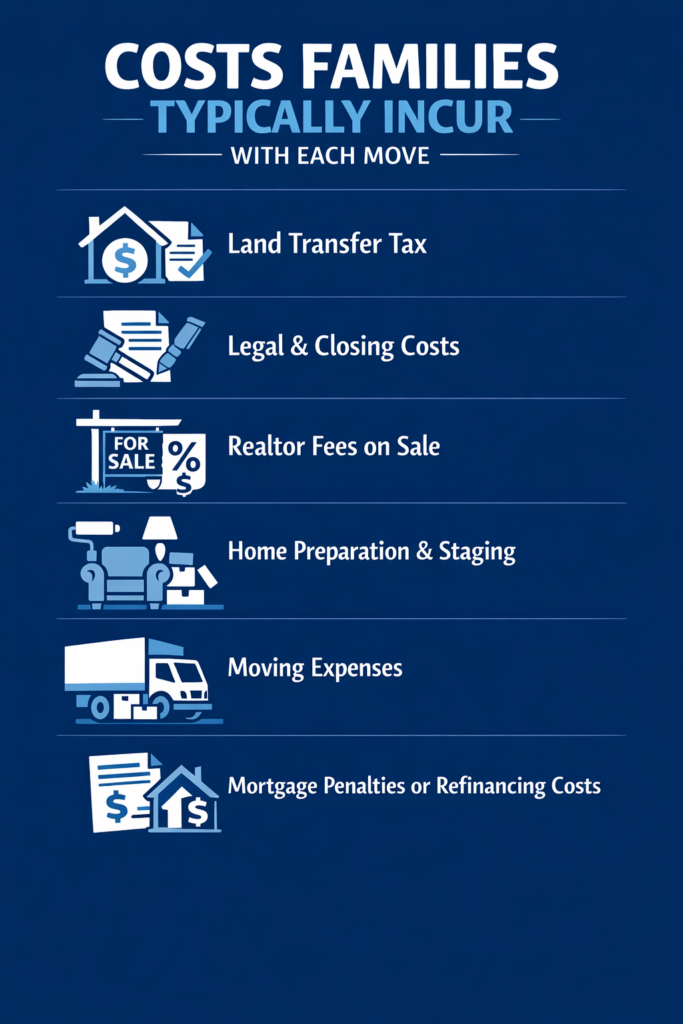
Here is a simple breakdown of what families typically incur with each move:
- Land transfer tax
- Legal and closing costs
- Realtor fees on sale
- Home preparation and staging
- Moving expenses
- Mortgage penalties or refinancing costs
Now multiply that by two.
Even conservative estimates place transaction costs for a Toronto move in the tens of thousands. When families commit to moving twice, they are often committing to six figure cumulative costs over a relatively short period of time.
That capital could otherwise be directed toward a larger down payment, renovation upgrades, education savings, or investment growth.
Market Appreciation Does Not Always Work in Your Favour
One common rationale behind moving twice is the belief that a smaller interim home will appreciate, creating equity for the next jump.
While Toronto real estate has historically shown long term resilience, appreciation is not uniform across all property types or neighbourhoods. The Canadian Real Estate Association regularly reports on price variations between segments and regions. Larger detached homes in established neighbourhoods often appreciate differently than smaller properties in transitional areas.
If a family purchases a temporary home in a moderate growth pocket and plans to later upgrade to a more competitive neighbourhood such as Bedford Park, the price gap can widen faster than anticipated.
Moving twice in that scenario means chasing a moving target. The final home may appreciate at a stronger pace than the interim property, making the second leap more expensive than originally planned.
Upsizing once allows families to enter their long term asset earlier. Appreciation then works on the larger property from day one, rather than delaying entry and paying additional transaction costs in the interim.
Interest Rate Exposure and Refinancing Risk
Interest rates have reminded Canadians how quickly borrowing costs can shift and how rate changes directly affect mortgage affordability and renewal terms. When you are moving twice, you are exposing your household to financing risk twice.
Each move can involve breaking a mortgage, renegotiating terms, qualifying under new stress test rules, or adjusting to a different rate environment. Lending criteria evolve. Household income may change. Employment situations shift.
Families who plan carefully for one transition can often structure their mortgage strategy with long term stability in mind. Those planning on moving twice must accept that the second move may occur in a less favourable rate climate.
Moving twice increases exposure to uncertainty. Upsizing once limits the number of times you must navigate financing volatility.

The Emotional Toll of Repeated Transitions
Financial math is only part of the story.
Moving is widely recognized as one of life’s most stressful events. When you commit to moving twice, you are committing to two periods of disruption.
Two rounds of packing and decluttering.
Two adjustments to new neighbours and community rhythms.
Two sets of school transitions or commute changes.
For families in neighbourhoods such as Playter Estates, where school catchments and community ties matter deeply, stability becomes part of long term lifestyle planning.
Moving twice can unintentionally extend a feeling of impermanence. Children may hesitate to form deep friendships. Parents may delay investing emotionally in community involvement. The home can feel transitional rather than foundational.
Upsizing once does not eliminate stress, but it consolidates it into a single, purposeful transition.
The Hidden Cost of Preparation and Presentation
Preparing a home for sale in Toronto has become increasingly strategic. Buyers are selective and presentation matters. If you plan on moving twice, you will prepare two homes for the market within a relatively short time frame.
That means two cycles of repairs, painting, decluttering, and professional staging. Two moments of living in a semi staged, semi packed environment while showings occur. Two periods where daily life feels paused.
Families often underestimate how disruptive the preparation phase can be. When you are balancing work calls, extracurricular schedules, and everyday routines, repeating that process within five years can feel exhausting.
Upsizing once consolidates that effort into a single well executed transition.
School Catchments and Long Term Planning
For many families between 35 and 55, children’s education heavily influences housing decisions.
If you are moving twice, you may be shifting catchments more than once. Even if you remain in the broader Toronto area, school boundaries can change meaningfully from one neighbourhood to the next.
In areas like Bayview Village, families often prioritize long term access to established public or private school options. Moving twice can interrupt continuity and require additional planning around transfers.
Upsizing once with a ten to fifteen year horizon allows families to align their housing decision with educational planning, rather than layering in another major move mid cycle.
Lifestyle Alignment Versus Incremental Upgrades
There is also a philosophical layer to this conversation.
Moving twice is often framed as cautious. Yet it can also reflect hesitation to define long term priorities clearly.
Are you seeking more space for growing children?
A dedicated home office for hybrid work?
Proximity to parks, transit, or aging parents?
A quieter street or a more vibrant urban setting?
When families take time to explore Toronto’s diverse communities through resources such as the neighbourhood guide, they often gain clarity about what truly matters for the next decade. Exploring local neighbourhoods can help families compare lifestyle tradeoffs more intentionally before making a decision that results in moving twice.
If the long term vision is relatively clear, upsizing once may provide greater stability and financial efficiency than taking an incremental step and repeating the process.

Inventory and Timing Realities
When inventory is tight, securing a suitable interim home and then repeating that process a few years later can prove challenging. Each transaction requires alignment between sale timing and purchase timing.
Families considering moving twice should reflect on how much appetite they have for navigating competitive bidding environments or extended listing periods more than once.
Reviewing current market activity through resources like our listings page offers insight into available inventory and price positioning, helping clarify whether two moves within a short period feel realistic.
When Moving Twice May Make Sense
There are scenarios where moving twice aligns with family needs. Significant income growth expected within a few years. Temporary relocation requirements. Caring for aging parents that requires proximity shifts.
However, these scenarios tend to be driven by clear external factors rather than general uncertainty.
For families whose primary motivation is incremental comfort or short term hesitation about stretching financially, it is worth running the numbers carefully. The cumulative cost of moving twice often outweighs the perceived safety of a smaller first step.
A Long Term Perspective
Upsizing families are rarely chasing square footage alone. They are seeking breathing room, stability, and alignment between home and lifestyle. Moving twice can dilute that clarity. It spreads financial resources across repeated transactions and prolongs transition periods. Upsizing once, when financially viable, allows families to consolidate costs, minimize exposure to market shifts, and establish roots with intention.
If you are weighing whether moving twice is the prudent route, thoughtful financial modelling is an essential first step. Conversations that begin with long term lifestyle planning rather than short term hesitation tend to produce more confident decisions. When families approach this stage with deliberation, the result is not simply a larger home. It is a more stable foundation for the years ahead.
If you are still weighing timing, financing structure, or broader personal circumstances, it can be helpful to step back and have a grounded conversation that clarifies your options in a measured and informed way. When decisions are framed within a ten to fifteen year horizon rather than a two to three year plan, the path forward often becomes clearer and more aligned with both financial stability and lifestyle goals.
Moving twice can feel strategic in theory. In practice, for many GTA families, upsizing once proves to be the more financially efficient and emotionally sustainable path.