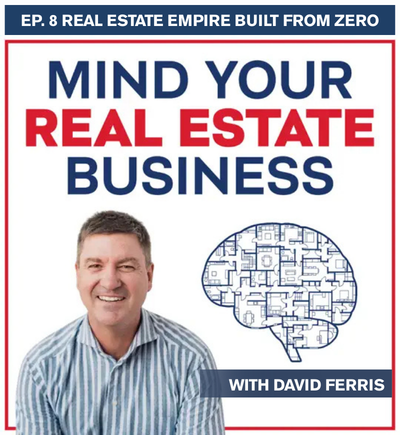
Is the “old school” real estate grind actually the new competitive edge?
Chris Cook sits down with his business partner David Ferris to unpack the practical, high-converting strategies that helped David build a thriving real estate business—from nearly zero to authority status.
Ditching expensive online leads and embracing traditional, budget-friendly methods like open houses, circle prospecting, and weekly emails, they share how authenticity, smart follow-up, and a deep understanding of buyer psychology are the real keys to long-term success in real estate.
Listen For:
1:43 DJ to REALTOR: David’s unconventional entry into real estate
6:10 70% of Deals from One Source
8:20 Get Them Talking: Psychology at Open Houses
13:51 The Power of Nosy Neighbor Open Houses
18:39 Weekly Emails That Actually Work
27:58 Scripts vs. Strategy
Connect with guest: David Ferris
LinkedIn | Website
Connect with Chris:
Website | Email
Read the Summary Below
Free Lead Generation That Actually Works
In this episode of Mind Your Real Estate Business, Chris Cook sits down with David Ferris—former DJ turned realtor and now business partner—to break down how he built a strong, sustainable business in just four years by mastering free lead generation strategies.
After experimenting with online lead generation and making hundreds of cold calls per week, David discovered that the most effective opportunities weren’t expensive or flashy—they were traditional, relationship-based tactics done exceptionally well. Open houses became his primary lead source, accounting for the majority of his deals. But the success didn’t come automatically. It came from refining the approach: building rapport, lowering buyer defenses, offering value first, and confidently booking strategy sessions instead of chasing commissions.
They also dive into:
- Why open houses position you as an authority in the marketplace
- How to run “nosy neighbor” open houses on Fridays to stand out
- Strategic circle prospecting that feels purposeful—not pushy
- The psychology of buyers and how small conversational shifts increase conversions
- The long-term power of a weekly email strategy with 60–80% open rates
- Why consistency over time builds momentum that compounds
A key theme throughout the conversation is value over desperation. Instead of leading with commission-driven conversations, David focuses on education, insight, and strategic guidance—making the “strategy session” the natural next step.
The biggest takeaway? You don’t need expensive leads or complicated funnels to build a thriving business. If you consistently execute on open houses, purposeful door knocking, and high-value weekly communication, you can create predictable growth—without draining your bank account.
Full Episode Transcript
David Ferris (00:00):
You’re already in a position of authority when your name’s on the sign, they see that you’re an active realtor who’s working that listing. I think there’s a certain kind of automatic respect that you get when you’re in that position as opposed to a faceless person calling you on the phone.
Chris Cook (00:27):
David Ferris, can I call you Diggy?
(00:33):
David Ferris, one of my team members to start and now my business partner and somebody that I think has really dug in quite deeply on building his business. He’s done quite a lot over the last, how long have you been licensed now, David?
David Ferris (00:54):
We’re four years
Chris Cook (00:55):
going on four years. What I want to talk about today is something that I think really resonates with what’s happening in the market, what’s happening with lead generation in general and all the other sort of the things that m empty out your bank account versus some of the free stuff that I think a lot of people are missing and something that you have really done well I think in particular in the last two years is leveraging some of the free opportunities that are available to you. We could do a little bit of an intro and who you are and all the other sort of thing. I think first of all, it’s fair to say you’ve got a really good database of people so we can set the stage a little bit for who you are.
David Ferris (01:43):
Yeah, definitely. Yeah. I came from my previous career of being a DJ and in the music business, which naturally you meet a lot of people through that scene. I have a large family, a large extended family, so between just kind of people I know through sports, my previous career and my family, it’s a lot of people. That being said, for some of the newer agents out there, your database, it’s hard to convert your database. In the first two years, it took about two years before anyone from my database actually used me as their realtor, and I think that’s a common theme from a lot of agents I’ve spoken with.
Chris Cook (02:31):
I can second that it was difficult for me to start getting people to recognize me as not the athlete, not the coach, but the go-to guy for real estate and I think that there’s a couple of things that we did right, early stages with you to help speed up that process. I’m trying to think about where the best place to start here is, and maybe we just start with where we started from and was it the value of doing the cold calls? We did a lot of online lead generation at the beginning and you made tens of thousands of phone. What was the value?
David Ferris (03:11):
Yeah, I think there was tons of value in that as far as just getting comfortable talking to people, getting comfortable in a sales role because ultimately that’s what this is. And then most importantly, the objection handling. I know you and you’ve coached me a lot on the objection handling. There’s some books that you’ve recommended that I’ve read. I can’t think of any of the titles off the top of my head
Chris Cook (03:40):
Exactly what to say for real estate agents by Dan something or other. Yeah.
David Ferris (03:45):
Yep. That was a good one. Good easy read. I’ve read that a bunch of times to just kind of refresh my memory on that stuff, but yeah, doing those, they weren’t exactly cold calls. They were coming in through Facebook ads and other online lead generation sources. There was a lot of people who obviously didn’t appreciate me calling their phone, and there were a lot of fuck offs and there were a lot of objections as you get. People are used to getting duct cleaners calling their phones five times a day, so we’re the second most hated people. Next to them is realtors. I think so,
Chris Cook (04:27):
Yeah, maybe I think the realtors, it’s the equivalent of being called by people trying to sell you online lead generation.
David Ferris (04:33):
Exactly. Exactly. But yeah, no, I think it was invaluable that just the experience I gained from just talking to people and we’re talking like, what do you think I was doing there? Like 300 calls a week.
Chris Cook (04:48):
Yeah. We had tracked it because we were big into the following. The metrics is like if I’m going to do this work, what’s the outcome? If I make a hundred phone calls, how many appointments am I booking out of those appointments? How many are converting? And the numbers got pretty horrible actually. And it wasn’t as you got better, the numbers didn’t get better, it became a saturated space.
David Ferris (05:11):
Yeah, very, very saturated space and I think that was when we kind of decided to fall back on some of the more traditional lead generation techniques. The tried and true open houses door knocking being probably the biggest ones,
Chris Cook (05:30):
And I think this is a perfect segue, I think because if you go online and you start going through on Instagram for example, everybody is basically saying there’s this new way of generating business and it doesn’t involve what these old school brokerages are promoting. The old way is dead. We see a lot of that sort of stuff, but I think what was interesting is it was about two and a bit years ago, you had gone back through and taken a look at where your sources of business had come from for the previous year
(06:10):
And it was a pretty eyeopening sort of thing because I think something like 70% of your deals had come from open house work that you had done where you met the seller or the buyer or you met somebody that lives in the neighborhood that’s looking to sell it. It was a big eyeopener I think for both of us really is you can spend a lot of time and money phoning people who maybe don’t have intent or their intent is very far off in the future, or you can talk to people who have enough intent that they’ve gotten in the car and come to see this particular us. There’s
David Ferris (06:51):
That, and I think there’s also part of it is you’re already in a position of authority when your name’s on the sign, they see that you’re an active realtor who’s working that listing. I think there’s a certain kind of automatic respect that you get when you’re in that position as opposed to a faceless person calling you on the phone.
Chris Cook (07:12):
I want to get your opinion on this. If you work in open house, you’re automatically going to get people that want to be your client.
David Ferris (07:18):
Is it automatic?
Chris Cook (07:19):
Yeah. No, no,
David Ferris (07:22):
I would agree.
Chris Cook (07:23):
Definitely
David Ferris (07:24):
Not.
Chris Cook (07:24):
You can do it wrong. You can start a conversation with are you working with a realtor?
David Ferris (07:32):
Well, yeah. It’s the commission breath we always talk about, right?
Chris Cook (07:35):
Yeah. One of the things that I’ve been developing alongside of all of the work that you’ve done at the open houses and starting with think about the psychology of the buyer that comes into an open house. I always sort of think one of the things that we want to do is get them talking. We want to get them talking to us. I don’t like to ask a question or when they come in, I don’t want to say, if you have any questions, come and I’ll answer all your questions for you. I like to do the have a look around. I would love it if you came back and gave me some feedback. And so just that one small change changed whether or not somebody came back to actually talk to me or they snuck out the door
(08:20):
When they did come back and talk to me, it opened up the opportunity for so much more conversation because they initiated it and this is the psychology of the buyer when they come in. We developed this whole strategy and we don’t have to go into all that. If anybody’s interested in knowing the whole strategy, just shoot me an email. I share it with everybody. I can say I share it with everybody because I think it’s important that we bring more buyers into the market with proper representation big time. And the more people that behave like a real estate agent, like a typical sort, I think we’re doing the industry of harm. So it’s something that I noticed when you talk to people, you do a really good job of bringing people back to you to talk to you some more about what they think of the house, and then there was something that you developed, I don’t know if you know that you developed it or not, but we had been talking and it was one of the things was has anybody taken the time to book a strategy session with you? And so we’ve developed that over time to, and I did an open house last weekend. I got three strategy sessions booked up. There were only eight people came through. If you do it right, if you say the right words in the right order, just the right way, you can convince people that you can actually be a trusted advisor. That was something that I think dispels the myths that the open house is a waste of time
David Ferris (09:48):
For sure. And even before we get to that strategy session conversation, I like to just kind of, if there’s any kind of way that I can break through on a personal level, I find that that’s a simple way to get people’s guard down. Whether they come in, they have a kid, oh, my kid’s that age too or anything, just I feel like it helps get their guard down a little bit and just speak to you more on a human level as opposed to someone who’s just after the commission.
Chris Cook (10:24):
I’ll share with you, so last weekend this couple came in and they had a baby in the baby carrier, the baby of urine thing, and so the three of them, mom, dad, and baby walk in through the front door and I go, who’s signing in? Are you signing in? And I pointed at the baby. They had zero sense of humor, so right away you’re like, oh, maybe I’m not the realtor for you anyway, right? The husband was like, yeah, fine, I’ll sign in. I was pointing at the baby, but that’s okay cutie.
David Ferris (10:58):
And at the end of the day, we want to work with people who see eye to eye with you on a personal basis as well. So if you’re an asshole, maybe I don’t want that business anyway, right?
Chris Cook (11:10):
Well, some people don’t appreciate maybe that I’m a smart ass. I do. That’s important. The other thing that I think is important, whenever you’re talking about building a business, we know just doing one thing is not enough. So if we did open houses, but then we also did online lead generation, those two things don’t go together particularly about, they’re two separate things. The same thing is open houses and running an event for your sphere. Those are two different things and they don’t naturally go together. They’re both could be very good things, but one of the things that I think if I’m going to make an investment of my time and my energy and some money, obviously the open houses basically free costs you some signs. We don’t cater them, we don’t do any of that sort of stuff. It’s more about meeting people in the neighborhood. But the things, the other two things that I think really go together really well with open houses is circle prospecting. If you’re going to door knock, do it with purpose.
(12:18):
I think you’re the same as me. I hate knocking on people’s doors just to say, do you want to sell? I would rather invite them to come to the open house that’s in the neighborhood, show them the staging that we’re capable of doing. So the circle prospecting specifically and doing it at intentional times, we get people to come in. I remember there was one, I think it was on Baltic, and you remembered the neighbors. You were like, oh, you’re from number 70 up the street there, and they were like, oh my god, this guy actually remembers knocking out by door. And that was something that I think you did really well do really well is if you’re going to circle prospect, we should remember the people that we talk to
David Ferris (13:02):
And gauge where are the conversations going. When I knock on doors doing the circle prospecting, my intent is not to have an in-depth conversation with you. My intent is to get you to come to that open house. We typically do the Friday kind of nosy neighbor one, and then that’s where I pounce on you is when you come through the open house. So it’s just a simple, yeah, we just listed this house. Often they’ll have some sort of insight, oh, I remember when they bought that house, or I remember, oh, this one sold. They want to engage. Everyone knows that their home is a super important asset and they want to know what’s happening in the neighborhood, so it’s pretty easy for them to lead the conversations and if they don’t want to, then you hand them the flyer and you move on to the next house.
Chris Cook (13:51):
You’ve mentioned something I don’t think a lot of people do. The nosy new door open house. How many signs do you see out on a Friday night? Yeah, not a lot. Not a lot. I’ve told a bunch of people that I coach, if you can’t find an open house to work, I think, and this would be for a newer agent or somebody that’s looking to give their business a shot in the arm. A lot of agents will do an open house the first weekend, but they won’t do one the second weekend. I know you’ve worked some second weekend open houses and had conversations, and I’m not sure if you’ve pulled clients from it or not, but we’ve certainly got names and phone numbers. But the one where I think a lot of people are dropping the ball is on the Friday night open house. So if I was a brand new agent, I’d never worked in open house and I was looking for an opportunity, everybody keeps saying no to me. Why not offer to run a Friday evening open house from five to seven, put the signs out earlier in the day, circle prospect, invite people to it,
David Ferris (14:52):
Tell the agent that you’re going to print up flyers, you’re going to go door knocking, you’re going to spread the word essentially. That’s great for their client and in their attempt to sell the property. So yeah, I think that’s a great opportunity for new agents who are trying to get out there and meet people.
Chris Cook (15:11):
You might even be able to get the agent whose open house it is to pay for those flyers, but somebody came to me and said, I’m going to do this for you. I’d say yes. Yeah, for sure. Yeah, of course, for sure. Lemme pay for the flyers. Off you go. It’s going to help me sell the house. I can advertise that to my seller client and say, we’re going to door knock. We’re going to do all this stuff. I think that there’s all kinds of open house opportunities. There’s seven days of the week where you could do, it doesn’t really make sense to do it on a Monday, but there’s Thursdays, you could do Thursday if it was summertime. I actually think I would probably think about doing the Friday night, open up Thursday during the summer, but so many people leave the city early on Friday, and I’ve heard people say in other markets like Ottawa, Friday dead in the summer, everybody’s gone. So you do it on Thursday? Yep. Go daily
David Ferris (16:03):
Thursday, 5:00 PM when people are coming home from work, they want to be nosy and check it out and yeah,
Chris Cook (16:11):
Conversations. That’s the second layer. So you get your open houses and there’s three that you can work a week. If you work two weekends, that’s six open houses that you could work out of those six. Let’s say you average four or five people through each run, and let’s say you had a 15% conversion rate to appointment, you’re probably going to get every month you’re going to get one client if you’re pretty average at her. And I think at our peak when things are going really well, we’re probably 25% conversion year to appointment to appointment. Not all those people are going to necessarily transact or want to work with you or whatever. That’s fine,
David Ferris (16:53):
But getting them to the appointment is the most challenging part. I find once we get them to that appointment, of course you’re going to have people who are quite ready or just whatever for whatever reason, don’t want to work with you, but for the most part, once you get them to that point, they’re convertible.
Chris Cook (17:13):
So we got open houses and then circle prospecting to promote your open houses or even to promote that the home sold. You could do a follow up circle, prospect and knock on those doors and say especially the people that you talked to or that came to the open house and say, Hey, I just want to stop by, let you know that we did sell the
David Ferris (17:31):
Place.
Chris Cook (17:32):
This is what it’s sold for. Would you like a property valuation or there’s any number of things that you can do around that. So there’s two layers. The third layer is stay in touch with the people that you meet, which can be quite challenging. I like scale, I like doing things at scale. If I could do it once and talk to everybody, that’s the way forward. One of the, you and I have been working on this now for going on three years is the weekly email and talking about, it’s just like any number of different topics. No, I can’t even recap half of the stuff we ended up talking about, but essentially we’ve been sending emails out to people, everybody in our database, the same email every week, or sorry, the same email to everybody, but a different email every week that we curate specifically, and we’ve worked hard on this to get it to be the precision thing. It is. I think I’m going to brag. I think you’ve got a 60% open rate, something
David Ferris (18:39):
Like that. Yeah. I’m not sure. I think you’re beating me in that department lately,
Chris Cook (18:46):
But between the two of us, we’ve got about 6,000 people. You’re on 60% open rate, which is amazing by the way. Most people get 18 to 25% and you got 60% and I’ve got 80% on these open rates. These are unheard of. If you could bottle it, which we did and put it out there, tell me, you do a weekly email, how many deals do you think you get a year from that weekly email?
David Ferris (19:14):
I think it’s one of those things that I’m still trying to pinpoint exactly what those numbers look like. I do believe that it’s working in the background and I don’t think you realize how well it’s working until it actually converts, if that makes sense. People who are thinking about doing something, maybe a year down the road, they’re reading, they’re paying attention, and then when the time comes, they’ll give you a call. So I’ll bump into people that I haven’t seen in years and Oh, I love the weekly emails that you’re sending, and it’s another touch point, and I mean we could speak on our strategy as far as what we’re writing. We make sure we keep them really short, put them in the Hemingway editor, make sure they’re very readable at a grade six level. I find, yeah, just making them digestible is so important. People will know that if they open them, it’s going to be a couple paragraphs. They’re going to get some good insight and carry on with their day.
Chris Cook (20:18):
I think the other thing along with that, even if it’s short and readable and delivered at the right time, but you’re regurgitating somebody else’s information, I have some background in journalism and if you report on a story that somebody else reported on yesterday, you’ll not sell very many newspapers.
David Ferris (20:47):
Yeah,
Chris Cook (20:49):
It’s old news. Nobody wants it. And so this is where I think a lot of people go wrong with their email newsletters that they send out where they take statistics and they take things that happened last month and they package it up and they send it to their database and then they wonder why the phone doesn’t work. I think if you’re going to do this, you have to be an authority. You have to be the source of the news, which gives, to be fair, I know it gives you some anxiety on Thursday afternoons. It gives me anxiety. We have to come up with something that’s newsworthy short, well-written with a good hook every single week. Admittedly, I copy yours sometimes and vice versa. But it’s something that I think if you really want to build a following, you got to think about this the same way a journalist would is you got to be the source of something. You got to have the guts to actually make some reasonable predictions on what you think is going to happen based on information available to you.
David Ferris (22:00):
And then it always feels cool when those predictions come true, and you can follow that up with an email a month later and say, remember when I said that this was going to happen? Well, it’s happening.
Chris Cook (22:11):
I don’t want to say I told you so.
David Ferris (22:14):
Yeah, right.
Chris Cook (22:15):
So it’s really powerful and even if you are wrong about something, if you’ve got it supported with data and you don’t do anything bold like saying the market’s going to crash by 25% or it’s going to go up or whatever, I like to say this is what’s happening and this is where I think the opportunities are.
David Ferris (22:35):
We
Chris Cook (22:36):
Do a lot of that. It’s like, where are the opportunities if you’re in this situation? But I think that that’s for the people that I work with, and even when we started, we did a lot of things that were not newsworthy and then we got beaten down for it. We got unsubscribed and we got a lot of things, bad open rates and even some bad comments where people were like, stop it and unsubscribe, whatever, like anything, this is where I’m going with this. I think if you take a look at anybody’s strategy, if you do something consistently for a long time, it will pay dividends. And so I think we’re still relatively in real estate terms, doing something for three years still isn’t really in my mind a long time.
(23:33):
There’s people out there that have been doing farming for 20 years, that’s all they do, but they used to geo Farm, do community events, doorknob, and then over time they could cut those other things out of their repertoire because the one thing, that farming thing, those mailers that go out twice a month have enough sort of connection with that neighborhood. So this where I look at what we’re doing and I think look at the success that we get from open houses weekly email and doorknocking, where are we going to be in three years from now as a result of that continued emphasis on
David Ferris (24:19):
Repeatability? Yeah, I think we’ll be doing good. Exponentially more successful,
Chris Cook (24:26):
We’d better be. It’s your fault. So I think if we could back up time and go four years ago and said, you know what? No cold calls. Let’s say that we never went down that road and you just did open houses weekly email and door market basically started a year early. Do you think you’d be in a better place?
David Ferris (24:49):
Hard to say for sure. I do think that the calling I do think was good training and I think, yeah, it’s hard to say. I think it took me a while too to get comfortable in the open houses as well, to speak intelligently about what’s happening in the market. I think there was a little bit of a learning curve there, but yeah, I got it pretty dialed in now for sure.
Chris Cook (25:15):
Yeah, I think with the open houses, I think I basically just, I left you out. I was like, all go do an open house. I don’t think there was any training there. I think I was just like, go do any together. Yeah, a little bit. I’m not sure. We did that many together. A
David Ferris (25:31):
Couple.
Chris Cook (25:32):
You threw me to the wolves. I think I did. But on the cold calling and all that sort of stuff, I think it’s important to have somebody that you can talk to, somebody that you can do this with. If I was to rewind it and go back in time, I would say I probably should have sat with you more, like we should have worked more together on those open houses. My advice to somebody that’s just getting started is maybe instead of just jumping straight in, go sit with an experienced open house person. Find somebody that does a really good job with these and go and hang out with them. Don’t try to go and cut their lunch. Don’t try to take clients. Keep your mouth shut and pay attention. Watch, learn. I think we’ve seen that before where people have gone to ez, they’ve never worked in open.
David Ferris (26:29):
Yeah, it’s just kind of awkward for everyone. Yeah, the people walking in, they can sense it too, right? When there’s that hint of desperation.
Chris Cook (26:42):
Yeah, or competition.
David Ferris (26:43):
Or competition within the, yeah, yeah.
Chris Cook (26:46):
Yeah. Probably not ideal to go into a competitive environment, open house. Yeah.
David Ferris (26:52):
Sounds like a really good reality TV show though. That’d be awesome.
Chris Cook (26:59):
That’s it, man, that’s, it’s crazy how you can boil down how you would brew success six to eight months if you were to do this. If you were to do these three things, open houses, weekly emails, and door knocking for six to eight months, I think you’d get a definite toll hold in the industry. The question is really at the end of the day, and where my advice to anybody that’s listening to this, if you want to do this, maybe you’ve been in the business for 10 years and you’ve never really worked open houses or you’ve worked open houses and you never get any clients from it, my advice would be to reach out, ask about if I work in open house, what’s the right, and I hate the word script because I think you have to be very agile. You have to have an idea of what it is you’re going to say and how you’re going to present this idea of a strategy session. Exactly what to say for realtors, basically.
David Ferris (27:58):
Yeah. It’s about having the right approach, like you’re saying, not an exact script because again, in this business, being authentic is so important and people can smell a rat when if you’re speaking in a script that doesn’t flow naturally, they’re going to know.
Chris Cook (28:16):
And I think that the last thing that I want to leave this with is, and where I think it’s a little bit of a slower game at the beginning, and we’re seeing a lot of momentum building now, is actually not having a lot of a heavy call to action, but instead offering a lot of value. So instead of thinking about buying, selling, or investing, call me for all your real estate needs. Talk about something very specific, offer a piece of value or advice or direction. If you’re going to knock on doors, have a reason to knock on gore outside of, I’m looking to sell your house. If you’re going to sit at an open house, look for opportunities for people that are out in the real estate, jungle, blind, they have no idea they’re going to open houses, man, any predator could grab them. So that’s where I think if you change your approach to, listen, I still want to ask for your business, but I want to do it in a way that’s going to provide value for you. I think that really has changed our uptake on the weekly email, the conversations that we’re having at open houses and the door knocking piece. If you knock on somebody’s door and you’re riding them to an event, a little bit more engaging.
David Ferris (29:39):
Part of it too is the confidence to know that you’re going to add value to the process. It’s like, why wouldn’t you want to sit down and have a strategy session with me? I’m going to be able to help you succeed and avoid costly mistakes to no brainer,
Chris Cook (29:59):
Uncomfortable question. I guess maybe not for you, but for some other people, do you think agents struggle with identifying their value?
David Ferris (30:07):
I do. I think there’s a lot of agents out there too, whether they want to admit it or not, they’re pretty desperate for that commission check and that it’s obvious.
Chris Cook (30:17):
Yeah,
David Ferris (30:18):
It’s obvious to the consumer when that’s the case.
Chris Cook (30:21):
My advice, I think if I was an agent and I was struggling to identify where my value was and it was undermining my ability to have conversations with people, the first thing I would want to do is to sit down with somebody that can clearly articulate what an region’s value is and give me those tours. What is the strategy session? How can I bring that to my people? How am I going to stand out from the other people that are in this industry so that I actually not a perceived value, it’s actual value, and in my head, I know that I’m person’s best option.
David Ferris (31:01):
Yeah, and is it the A BR course? I did that when I was a relatively new agent with Barbara Brindle, and that was incredible. I actually want to do it again because it’s been a couple years, and just having her articulate the value add that we can bring as realtors was super important to do, so I’d recommend that as well.
Chris Cook (31:28):
I think anytime you can do a course or something like that, but it boils down to is coaching. You’re not going to have all the answers, especially if you’re an agent. And let’s face it, we get paid exceptionally well for the work that we do so that the product that we produce should be exceptional. And in order to make that happen, I don’t think anybody’s born exceptional at this business or out of any of that. You have to work on, you have to train, you have to get educated. So that’s where I’d say reach out to a coach. If you’re wondering where to start, reach out to me right on this email like go ch***@*********rk.com, send me an email and get some of the strategies put in place so that you can get your business up and running and build your confidence to be able to, well, to be this guy and become David Ferris. Thanks. I appreciate your time today. It’s for sure, a little bit. For sure. Always good to talk to a familiar person, and I think you and I have shared values, so it’s easy conversation. I hope that everybody out there, this thing got value from David.
David Ferris (32:40):
Yeah, for sure. Again, yeah, feel free to reach out to me as well. I’m a relatively newer agent, but yeah, I’ve been building a pretty good business from the open houses and the circle prospecting and all that, so if you have any questions about it, feel free to reach out.
Chris Cook (33:04):
Here are the top three things I got from David Ferris today. Mastering lead conversion through open houses. David transitioned from cold calling to focusing on open houses, which became his most effective lead source. He positions himself as an authority by hosting listings. He initiates meaningful human conversations that are not commission driven, and he uses open houses to book strategy sessions and build trust with serious buyers. The second thing is strategic circle prospecting. David effectively uses door knocking, not to hard sell, but to invite neighbors to events like open houses, making the outreach feel purposeful and less transactional. Third, building a high performance weekly email campaign. David has a weekly email strategy that has a 60% plus open rate. This is well above any industry averages. David’s gains here includes staying top of mind with his sphere, learning to write a short, readable, and journalistic style, establishing himself as a source of insights, not just a salesperson. Thanks for checking out the podcast. Please follow the podcast so you don’t miss a single episode. And if you can leave us a rating as well as a review to tell others that this is worth listening to. Thanks for listening.