
If you are a growing family weighing your next move, one of the first questions on your mind is likely: how long does it take to buy a house? It is a practical question, and the honest answer is that it depends on more variables than most people anticipate.
For upsizing families in Toronto, the purchase timeline is shaped by a combination of market conditions, financial preparation, school year planning, and the added complexity of selling your current home at the same time. Unlike a first-time purchase, an upsize is a layered transition, and understanding the stages can help you plan with confidence rather than react under pressure.
Below is a realistic look at each phase of the process and how long each one typically takes.
Phase One: Getting Financially Ready (Four to Eight Weeks)
Before you can answer how long does it take to buy a house, you need to understand how long it takes to get ready to buy one.
For most upsizing families, financial preparation begins with a mortgage pre-approval. This involves gathering documentation including recent pay stubs, T4s, tax returns, and statements of any existing debts or assets. Your lender will assess your income, existing equity, and borrowing capacity based on your current financial picture.
This process typically takes one to three weeks if your documents are organized, though it can extend if there are complications such as self-employment income, commission-based earnings, or a rental property to account for.
Beyond pre-approval, upsizing families also need to think through their equity position. If your current home has appreciated significantly, that equity may form a substantial portion of your down payment on the next property. Understanding how much you would net from a sale, after mortgage discharge, legal fees, and moving costs, shapes what you can realistically afford in your next home.
Taking time at this stage to model different scenarios with a financial advisor or mortgage professional will save you from surprises later. Rushing past the financial preparation phase is one of the most common reasons buyers feel uncertain once they are actively searching.
Phase Two: Defining Your Search Criteria (Two to Four Weeks)
Once your finances are clear, the next stage is narrowing down what you are actually looking for. For families asking how long does it take to buy a house, this phase is often underestimated.
Beyond square footage and bedroom count, upsizing families tend to weigh school boundaries, commute times, proximity to extended family, and long-term neighbourhood trajectory. These conversations between partners take time, and the conclusions you reach here will direct everything that follows.
It is also worth exploring neighbourhoods you may not have considered previously. Areas such as Little Italy or Markland Wood offer larger detached homes with strong school options and reasonable access to downtown.
Families who skip this phase often cycle through dozens of showings without clear direction. Spending a few weeks defining your non-negotiables will compress your active search phase considerably.
Phase Three: The Active Search (Four to Twelve Weeks)
This is the phase most people imagine when they ask how long does it take to buy a house. The honest answer is that it varies enormously.
In a balanced market, well-prepared buyers in Toronto typically find a suitable property within six to ten weeks of active searching. In a competitive market where well-priced homes in desirable neighbourhoods move quickly, some families find the right home within two or three weeks. In a slower market with limited inventory in a specific price range, the search may stretch to three months or more.
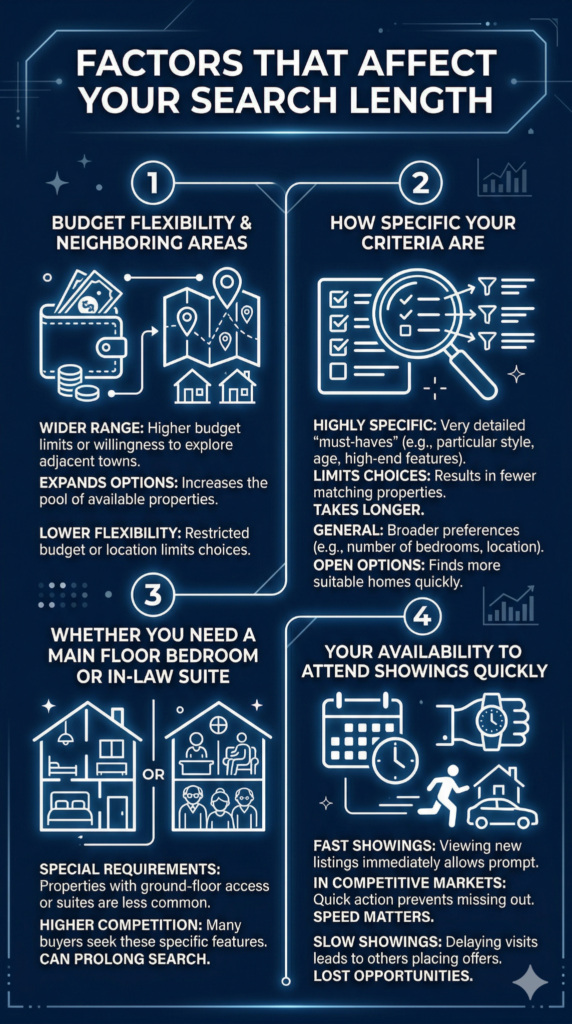
The factors that affect search length include:
- Budget flexibility and willingness to consider neighbouring areas
- How specific your criteria are around style, layout, and school catchment
- Whether you need a main floor bedroom or in-law suite for multigenerational living
- Your availability to attend showings quickly in a fast-moving market
Browsing current listings in Toronto is a useful way to calibrate your expectations. Seeing what is available at different price points helps you understand whether your criteria are realistic or whether some adjustments are needed before the search begins in earnest.
It is also worth noting that Toronto’s market shifts seasonally. Spring tends to see the highest inventory levels, which can work in a buyer’s favour. If you begin your financial preparation in January or February, you are well-positioned to move through the active search during the most active listing period of the year.
Phase Four: Offer, Conditions, and Firm Agreement (One to Three Weeks)
Once you find the right home, the next question of how long does it take to buy a house shifts to the offer and negotiation stage.
In competitive situations, offer nights in Toronto can move within 24 to 48 hours of a listing going live. In a more normalized market, there may be room for negotiation over several days. Having your pre-approval letter and a deposit ready in advance allows you to move decisively when the right home appears.
Most purchase offers include a condition period, typically five to ten business days, during which you complete a home inspection and finalize your mortgage financing. If your offer is accepted with conditions, this phase typically resolves within one to two weeks, assuming no significant inspection issues arise.
Once conditions are waived or fulfilled, your agreement becomes firm and the purchase moves to the closing phase. From accepted offer to firm agreement, plan for one to three weeks depending on what conditions are included.
Phase Five: Closing and Possession (30 to 90 Days)
The period between a firm agreement and the day you receive the keys is known as the closing period. For upsizing families asking how long does it take to buy a house, this stage is often more flexible than people expect.
Closing timelines in Toronto are typically negotiated as part of the offer. A 60 to 90 day close is common for move-up buyers because it aligns the timing of selling your existing home with the possession of your new one. A shorter 30-day close may work if you have already sold or are bridging with financing, while a longer 90-day or more close may suit families who need to align school-year transitions or job changes.
Your real estate lawyer will handle title searches, mortgage registration, and the transfer of funds during this window. Legal fees for a purchase in the Toronto area typically range from $1,500 to $2,500 plus disbursements, depending on the complexity of the transaction.
The closing period is also when most families begin coordinating movers, updating address information, and planning the logistics of the physical move. Starting these tasks early, ideally four to six weeks before possession, reduces stress considerably.

The Parallel Process: Selling Your Current Home
One of the most important factors that shapes how long does it take to buy a house for upsizing families is the simultaneous sale of their current property.
Most families do not want to carry two mortgages, which means coordinating the sale of their current home with the purchase of their next one. This is where timing becomes both strategic and stressful.
There are a few common approaches. Some families sell first and then buy, accepting a period of temporary housing or a bridge between closings. Others buy first with a longer closing date, giving them time to list and sell their current home before the new closing occurs. A third option is to list and make offers simultaneously, aiming to coordinate both timelines within a narrow window.
Each approach carries trade-offs around certainty, financial exposure, and logistics. The right strategy depends on your specific equity position, your risk tolerance, and current market conditions. This is one of the areas where working with a realtor who specializes in helping families upsize adds the most value, as the sequencing of these two transactions can significantly affect your outcome.
Realistic Total Timeline for Upsizing Families
When you add up each phase, the realistic answer to how long does it take to buy a house in Toronto when upsizing is between four and nine months from first preparation to possession day.
A compressed but achievable timeline looks like this: two months for financial preparation and criteria setting, two to three months of active search, two to four weeks to firm up an offer, and sixty to ninety days to close. Families who are well-prepared and working in a market with reasonable inventory can move through this process in approximately five to six months.
Families who are less prepared, more specific in their requirements, or navigating a tight inventory environment may find the process takes closer to nine to twelve months from the time they begin thinking seriously about the move.
The best way to compress this timeline is to start earlier than you think necessary. Begin the financial conversations six months before you intend to buy, not six weeks. This gives you room to address any complications, build a clear picture of what you can afford, and enter the active market with confidence.
Starting With Clarity
The question of how long does it take to buy a house does not have a single answer, but it does have a clear starting point. Preparation.
For upsizing families in Toronto, the difference between a smooth transition and a stressful one often comes down to how early the planning begins. Families who treat the process as a six to twelve month project rather than a short sprint tend to arrive at possession day feeling settled rather than stretched.
If you are beginning to think seriously about upsizing, taking the time to understand your financial position, explore neighbourhoods that fit your evolving needs, and align on priorities as a household will make every subsequent phase more manageable.
Reaching out to a realtor who understands the specific dynamics of upsizing in the Toronto market can also help you build a realistic, well-sequenced plan. The Halyard Group works exclusively with families navigating this transition, and an early conversation can bring clarity to a process that often feels more uncertain than it needs to be.