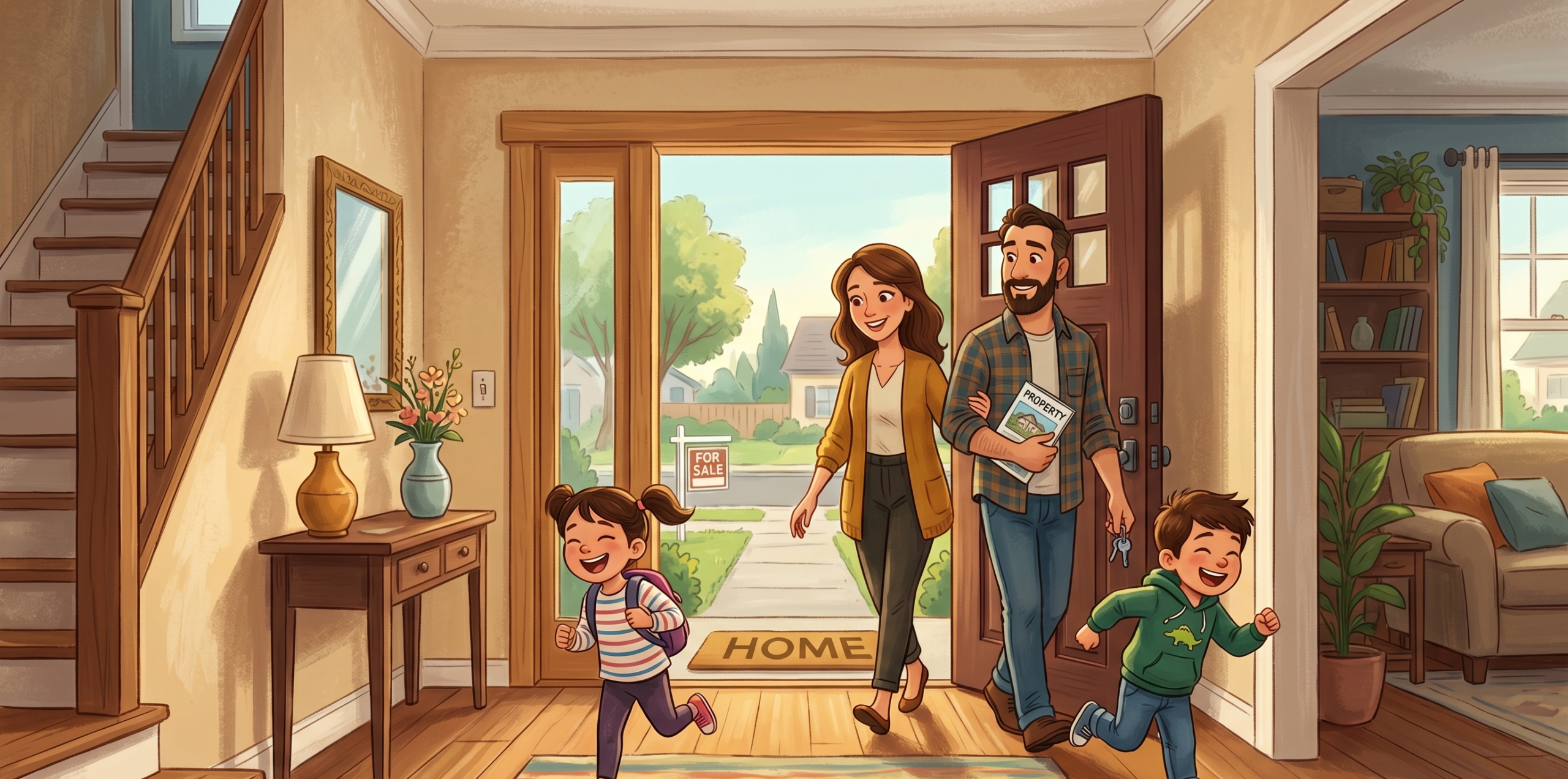
Selling a family home in Toronto is a different exercise than selling to first-time buyers or downsizers. The people walking through your door are often parents themselves. They are not just evaluating finishes and square footage. They are mentally moving their family in, picturing morning routines, imagining where the backpacks land, and silently calculating whether the layout will hold up under the weight of real family life.
Buyers with kids notice things that other buyers walk right past. A door that swings into a tight hallway. A powder room that sits too far from the backyard. A kitchen that faces away from the living space where young children play. These details are not incidental to their decision. They are often central to it.
If you are preparing to sell a move-up home in Toronto, understanding what buyers with kids are actually registering during a showing can help you present your property more effectively and price it with greater confidence.
The Layout Is Read as a Daily Logistics Map
Before buyers with kids have consciously formed an opinion, they are already mapping their daily routine onto your floor plan. They are thinking about breakfast and school drop-off. They are noting whether the kitchen has sight lines to a play area or backyard. They are observing whether there is a natural transition zone near the entrance where shoes, coats, and bags can be managed without spilling into the main living space.
Open-concept layouts that connect the kitchen to a family room tend to resonate strongly with this group, particularly when children are young. The ability to supervise while cooking, or to remain connected to the household while managing one task, is not a luxury for parents. It is a functional requirement they have been missing in their current home.
Layouts where the kitchen is isolated, or where the primary living spaces are spread across multiple disconnected rooms, often register as friction. Buyers with kids may not articulate it this way, but the feeling they leave with is that the home would be hard to manage.

Storage Is Evaluated With Specific Scenarios in Mind
Every buyer wants storage. Buyers with kids want it in specific places and forms. A mudroom, or even a generous entry area with hooks and a bench, is noticed immediately and often mentioned first in post-showing feedback. For families managing multiple children’s coats, sports gear, and school bags on a daily basis, a dedicated landing zone near the entrance is not a staging detail. It is a problem they are actively trying to solve.
Closet depth and layout in children’s bedrooms also draws attention. Parents mentally project growth: will this closet still work when a toddler becomes a ten-year-old with twice the belongings? Reach-in closets with adjustable shelving read better than shallow or awkwardly shaped storage that requires custom solutions.
Basement storage, garage organization systems, and pantry space round out the picture. Buyers with kids are often coming from a home where every inch of storage is already spoken for. A property that demonstrates thoughtful storage throughout the home signals that it was designed or maintained by people who understood how families actually live.
The Backyard Is Assessed as a Second Living Space
For buyers with kids, the backyard is not landscaping. It is usable square footage. During a showing, parents are noting whether there is enough flat, open space for children to run and play. They are checking the fencing, both its height and its condition, and quietly calculating whether it would contain a toddler or a dog.
Privacy matters here too. A yard that backs onto a busy alley or feels exposed to multiple neighbouring sightlines will register differently than one that feels sheltered and self-contained. Neither is necessarily a dealbreaker, but buyers with kids are making these assessments in real time.
Decks and patios also read differently to this group. A large deck with room for a dining table and some play space signals a home where family outdoor life has been thought through. A yard that has been entirely devoted to garden beds with no hardscape or open lawn may feel impractical, regardless of how beautifully it is maintained.
Bedroom Separation and Flexibility Matter
The number of bedrooms gets confirmed before the showing. What buyers with kids are evaluating in person is more nuanced: how the bedrooms relate to each other, how they function for different ages, and whether the layout gives the household some degree of acoustic and spatial separation.
A primary bedroom on a different floor from children’s rooms is generally viewed positively by parents of young children and older kids alike, though for different reasons. For families with infants or toddlers, proximity to the nursery is the priority. For families with teenagers, separation becomes more desirable. Understanding your likely buyer’s stage of family life can help you frame these features in the most relevant way.
Buyers with kids also notice whether secondary bedrooms are genuinely functional or merely technically present. A bedroom that fits only a single bed with no room for a desk or dresser will not read as a usable child’s room to a family planning for the medium term. Furniture placement during staging can make a significant difference in how these rooms are received.

Bathrooms Are Stress-Tested Mentally
Bathroom count and placement carry outsized weight for buyers with kids. A home with three bedrooms and a single full bathroom will immediately register as a potential daily bottleneck. Even if the square footage and finishes are strong elsewhere, the bathroom configuration can become the reason a family moves on.
The location of bathrooms relative to bedrooms and common areas is also noted. A powder room on the main floor, accessible from both the kitchen and the backyard entrance, is a practical detail that parents recognize and value. It reduces the traffic through private areas of the home during daily activity and during gatherings.
Ensuite bathrooms in the primary bedroom are increasingly expected at the move-up price point. Buyers with kids who are upsizing from a starter home or condo are often doing so specifically to gain this separation. If your home has it, it is worth ensuring it reads clearly and presents well during showings.
Safety Details Are Noticed, Often Unconsciously
Buyers with kids perform a kind of ambient safety scan during a showing that they may not consciously acknowledge but that shapes their emotional response to a property. Stair railings that feel loose or are spaced too widely. Sharp countertop corners in kitchens used heavily by young children. A pool or hot tub with no visible barrier. A garage that opens directly into the kitchen without a step or separation.
None of these details will necessarily appear in a buyer’s written feedback. However, they contribute to the overall sense of whether a home feels manageable and safe for their family. Properties that have been thoughtfully maintained, with railings secured, hardware updated, and hazards addressed, tend to generate stronger emotional comfort from this buyer group.
This is one of the reasons that pre-listing maintenance and a careful walkthrough of the home from a parent’s perspective can be worthwhile before going to market. Small repairs that seem cosmetic to a seller may carry more significance to buyers with kids walking through for the first time.
The Neighbourhood Arrival Experience Shapes the Showing Before It Starts
Buyers with kids begin evaluating a property the moment they turn onto the street. The drive in, the sidewalk condition, the proximity of nearby schools and parks, the general feel of the block as a place where children move through safely on foot: all of this is processed before they step through the front door.
This is why the homes that tend to perform best with family buyers are not only well-presented inside but are situated on streets that read as livable and community-oriented. Families exploring areas like Birch Cliff or Playter Estates are often drawn as much by the feel of the surrounding blocks as by any individual property’s features.
If your home is in a neighbourhood with strong family appeal, that context should be part of how the property is presented and marketed. If the street itself has strong walkability, good school access, or proximity to parks, these points reinforce the overall value proposition for buyers with kids evaluating the full picture.
How to Present Your Home With This Buyer in Mind
You do not need to stage a home to look like a showroom to appeal to buyers with kids. In fact, a space that feels too pristine can be harder for families to mentally inhabit. What matters more is that the home communicates ease: that living here with children would feel manageable, organized, and comfortable rather than like a daily battle against the layout.
Clear the entryway so the arrival experience feels spacious and functional. Ensure that children’s bedrooms are staged with appropriate furniture to convey the real usability of the room. Present outdoor spaces in a way that communicates how the yard has been used, not just how it looks. Address any deferred maintenance that a parent doing a safety scan would notice, even if it feels minor from a seller’s perspective.
Reviewing active listings in Toronto that are targeting the same buyer profile can also help you understand how comparable properties are positioning their family-relevant features and where there may be an opportunity to differentiate your home.
The Details That Close the Gap
Buyers with kids make emotional decisions backed by practical logic. When the layout works, when the storage is there, when the backyard feels right and the bathrooms are sufficient, they stop calculating and start imagining. That shift, from assessment to aspiration, is what drives a competitive offer.
Understanding what this buyer group is actually noticing during a showing does not require major renovations or expensive staging. It requires a clear-eyed look at your home through a different set of eyes. The eyes of someone who has been managing a family in too little space and is now deciding whether yours is finally the one that fits.
Sellers who take the time to see their home this way, and who work with an agent who understands the priorities of upsizing families in Toronto, are consistently better positioned to attract serious buyers and achieve stronger results.