For decades, the concept of a starter home shaped how Canadians entered the housing market. Buy small, build equity, then move up. In Toronto, that path no longer fits every buyer. Increasingly, first-time purchasers are choosing to skip the starter home altogether, aiming instead for homes that can support longer-term living from the outset.
This shift is not about excess or impatience. It reflects changing economics, family structures, and a more cautious approach to long-term planning. Understanding why some buyers skip the starter home helps contextualize how Toronto’s market has evolved and why traditional advice does not always align with today’s realities.
The Changing Economics of Entry-Level Housing
One of the most significant reasons buyers skip the starter home in Toronto is cost. Entry-level properties no longer offer the same affordability gap they once did. Condominiums, townhomes, and smaller detached homes often come with price points that feel disproportionate to their long-term usability.
When the cost difference between a short-term home and a longer-term property narrows, buyers begin to question whether multiple transactions make financial sense. Land transfer taxes, legal fees, moving expenses, and renovation costs add up quickly. For some households, especially dual-income families, it can be more practical to stretch once rather than move multiple times.
Equity Building Is No Longer Guaranteed in the Short Term
The traditional logic behind a starter home relied on steady appreciation over a relatively short holding period. In today’s market, appreciation timelines are less predictable. Buyers who skip the starter home often do so because they are less confident that a three to five year hold will meaningfully improve their purchasing power.
Market cycles have lengthened, and price growth is not evenly distributed across property types. This makes it harder for entry-level buyers to rely on rapid equity gains as a stepping stone.
Lifestyle Stability Has Become a Priority
Many first-time buyers today are older than previous generations were at purchase. With established careers, children, or plans for family growth already underway, the tolerance for short-term housing is lower. Choosing to skip the starter home allows buyers to prioritize stability over constant transition.
This is particularly true in Toronto, where changing neighbourhoods can mean changing schools, childcare arrangements, and daily routines. Buyers increasingly want a home that can accommodate evolving needs without requiring another move in the near future.
Neighbourhood Fit Matters From Day One
When buyers skip the starter home, neighbourhood choice becomes even more critical. Rather than focusing solely on entry price, buyers are evaluating long-term livability. Access to transit, schools, parks, and community services often outweighs square footage alone.
Neighbourhoods such as Bloor West Village frequently appeal to buyers taking this approach. This area offers established infrastructure and a sense of permanence that supports longer-term living. Exploring neighbourhood profiles can help buyers understand whether an area aligns with both current needs and future plans.

The Impact of Family Help and Intergenerational Planning
Another factor influencing why buyers skip the starter home is family support. Gifts, early inheritances, or co-purchasing arrangements can change purchasing power significantly. While not universal, this dynamic is increasingly common in high-cost markets like Toronto.
Intergenerational planning often shifts the goal from short-term entry to long-term security. Parents may view housing support as a way to help their children avoid multiple costly moves, particularly in a market where transaction costs are high. Buyers who skip the starter home with family assistance often feel a greater responsibility to choose carefully, knowing the decision carries shared financial and emotional weight.
This dynamic also encourages longer holding periods. Rather than treating the home as a stepping stone, families are more likely to prioritize neighbourhood stability, long-term adaptability, and resale resilience over short-term appreciation. In these cases, buying a home that can serve as a multi-decade residence becomes more important than following a traditional progression.
Renovation Fatigue and Time Constraints
Starter homes often require compromises, including renovations that buyers expect to tackle gradually. In theory, these projects add value over time. In practice, many buyers underestimate the disruption involved.
For households balancing demanding careers, childcare, and long commutes, renovation fatigue can set in quickly. Even small projects consume time, mental energy, and financial resources. Buyers who skip the starter home frequently cite a desire to avoid years of incremental work in favour of a home that functions well from the outset.
In Toronto’s older housing stock, renovations can also uncover unexpected issues that increase costs and delay timelines. Choosing a more complete home can reduce stress and allow families to focus on settling into their routines rather than living in a constant state of transition.
Financing a Longer-Term First Purchase
From a financing perspective, choosing to skip the starter home requires careful planning. Larger mortgages, longer amortizations, and conservative budgeting all play a role. Buyers taking this path tend to focus less on maximum approval amounts and more on sustainable monthly costs.
Households that plan for long-term affordability rather than short-term qualification experience greater financial confidence. This mindset aligns closely with buyers who prioritize stability over incremental moves.
Market Volatility Encourages Fewer Moves
Market uncertainty has also contributed to why buyers skip the starter home. Fluctuating interest rates, tighter lending conditions, and shifting buyer sentiment make frequent transactions feel riskier than they once did. Each move introduces exposure to timing risk, including the possibility that market conditions may not align when a buyer is ready to sell.
For buyers who plan to stay in Toronto long term, purchasing once and holding through multiple market cycles can feel more predictable than relying on short-term appreciation. When buyers skip the starter home, they often accept that markets will move up and down, but they place greater importance on being comfortable in their home regardless of external conditions.
One Practical Trade-Off Framework
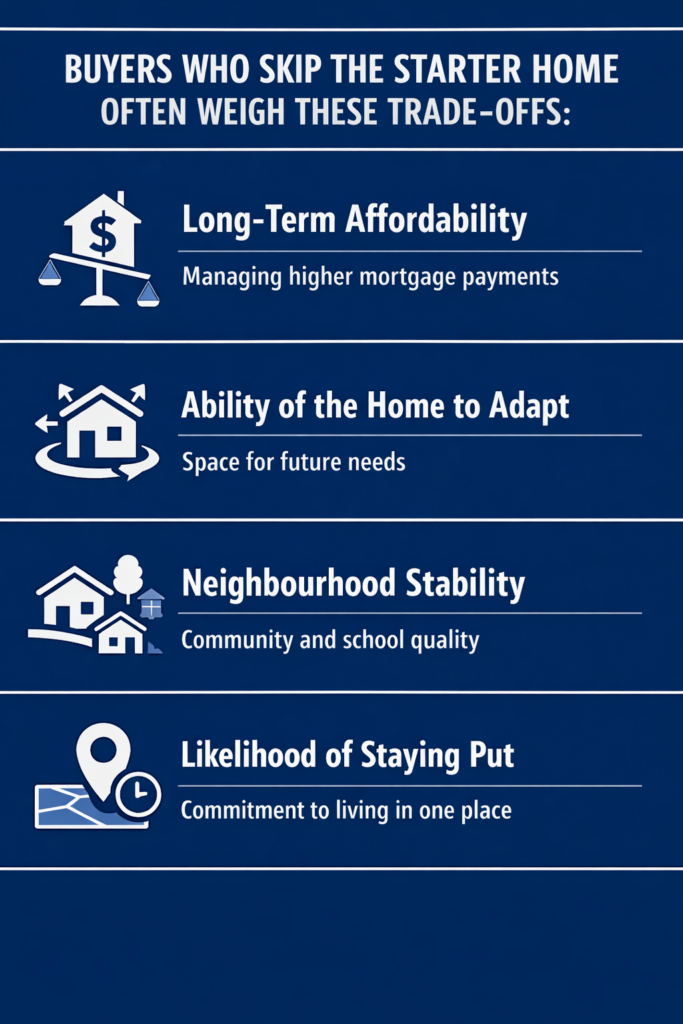
While motivations vary, buyers who skip the starter home often weigh a similar set of trade-offs before committing. This process typically includes one focused evaluation rather than multiple reactive decisions.
Common considerations include:
- Long-term affordability and comfort with carrying costs
- Ability of the home to adapt to family growth or change
- Neighbourhood stability and access to services
- Likelihood of staying put for ten years or more
Keeping the evaluation narrow helps buyers make confident choices without overextending.
When Skipping the Starter Home Makes Sense
Choosing to skip the starter home is not inherently better or worse than a traditional path. It simply reflects a different risk profile and set of priorities. For buyers with stable incomes, long-term career plans in Toronto, and a clear vision for family life, skipping stages can reduce disruption and provide a stronger sense of continuity.
This approach often works best for households that value neighbourhood permanence and are prepared for the responsibilities of a larger or more complex property from the outset. Buyers who skip the starter home tend to look at maintenance, long-term costs, and how the home will function across different life stages, which aligns closely with trends the majority of families are watching in 2026.
At the same time, this strategy requires discipline. Stretching too far financially or choosing a home that limits flexibility can create stress over time. Thoughtful planning is what separates a strategic decision to skip stages from an emotional one driven by fear of missing out.
Seeking Informed Perspective
For buyers navigating this choice, access to grounded, local insight can be valuable. Understanding how different neighbourhoods, property types, and price points perform over time helps buyers evaluate whether skipping stages aligns with their goals.
Having a conversation with experienced professionals can provide context that supports long-term thinking rather than short-term pressure.
Rethinking the First Step
The idea that every buyer must start small is increasingly outdated in Toronto’s market. For many households, choosing to skip the starter home reflects careful analysis rather than excess ambition. It is often the result of weighing transaction costs, lifestyle disruption, and long-term financial goals.
For buyers who plan to remain in the city for many years, the traditional ladder approach can feel inefficient. Each move introduces friction, from emotional stress to financial leakage. By contrast, purchasing a home that can support a longer horizon allows families to invest more deeply in their neighbourhoods and routines.
Ultimately, deciding to skip the starter home is about aligning housing with life, not trends. When buyers prioritize long-term livability, sustainable finances, and community fit, their first purchase can also be their most deliberate one. In a complex market like Toronto, this reframing offers clarity and confidence rather than constraint.