Unlike many other closing costs, which tend to be modest and predictable, land transfer tax in Toronto carries real weight. Buyers in the city face a double obligation: both a provincial tax and a municipal one, layered on top of each other. For a family purchasing a home in the range that most upsizing moves require, the combined total can reach tens of thousands of dollars.
Understanding how land transfer tax in Toronto works before you are deep into a transaction is one of the most practical things a family can do. It affects how much cash you need to have ready at closing, and it should factor into your overall budget from the moment you begin seriously planning a move.
How Land Transfer Tax in Toronto Works
Ontario charges a provincial land transfer tax on every property purchase in the province. The tax is paid by the buyer at closing and is calculated as a percentage of the purchase price using a marginal rate structure, meaning different portions of the home’s value are taxed at different rates.
What makes land transfer tax in Toronto distinct is that buyers within the city’s boundaries face a second, parallel tax: the Municipal Land Transfer Tax (MLTT), administered by the City of Toronto. Both the provincial and municipal taxes use the same marginal rate structure, and both apply simultaneously. The result is that buying a home in Toronto effectively doubles the land transfer tax obligation compared to buying the same home just outside the city’s borders. The official rates are published by the City of Toronto and updated as rate changes come into effect.
The municipal tax applies to all purchases within Toronto’s official boundaries: south of Steeles Avenue, east of Etobicoke, west of Scarborough, and north of Lake Ontario. Families purchasing in surrounding municipalities such as Mississauga, Markham, or Vaughan pay only the provincial tax.
The Rate Structure for Upsizing Buyers
Both the provincial and municipal land transfer taxes in Toronto follow the same marginal rate tiers for residential properties with up to two single-family residences:
| Purchase Price Portion | Rate |
| Up to $55,000 | 0.5% |
| $55,001 to $250,000 | 1.0% |
| $250,001 to $400,000 | 1.5% |
| $400,001 to $2,000,000 | 2.0% |
| $2,000,001 to $3,000,000 | 2.5% |
Source: City of Toronto / Ontario Ministry of Finance
Since most upsizing families in Toronto are purchasing in the range where the majority of the home’s value falls into the 2.0% bracket, the land transfer tax in Toronto compounds quickly. Due to the fact that both the provincial and municipal taxes apply, the effective rate on that middle portion of the purchase is 4.0% combined.
It is worth noting that as of April 1, 2026, new graduated MLTT rates take effect for properties priced above $3 million. Families purchasing in that range should confirm the updated figures directly with their lawyer, as the municipal portion increases meaningfully at those thresholds.
What Does This Look Like in Real Numbers?
For upsizing families, the figures become significant quickly. Consider a family purchasing a detached home in a sought-after Toronto neighbourhood for $1.5 million, which sits comfortably within the range many move-up buyers are targeting.
On a purchase at that price, the provincial land transfer tax would total approximately $22,950. The municipal land transfer tax would add a nearly identical amount. Combined, the land transfer tax in Toronto on that purchase approaches $46,000 due at closing, in addition to any legal fees, home inspection costs, title insurance, and other transaction expenses.
At $2 million, the combined land transfer tax obligation climbs to roughly $64,000. These are not incidental costs. For families who have been focused primarily on their mortgage and down payment, encountering these figures late in the planning process can create real strain.
Why First-Time Buyer Rebates May Not Apply to Upsizing Families
Ontario and the City of Toronto both offer land transfer tax rebates for first-time home buyers. The provincial rebate covers up to $4,000, and the municipal rebate covers up to $4,475, for a combined maximum of $8,475. These rebates are meaningful for eligible buyers.
However, upsizing families are generally not eligible. The rebate requires that neither buyer nor their spouse has previously owned a home anywhere in the world. For families selling a current property and purchasing their next one, the rebates do not apply. Land transfer tax in Toronto will need to be budgeted in full.
How to Factor Land Transfer Tax Into Your Upsize Budget
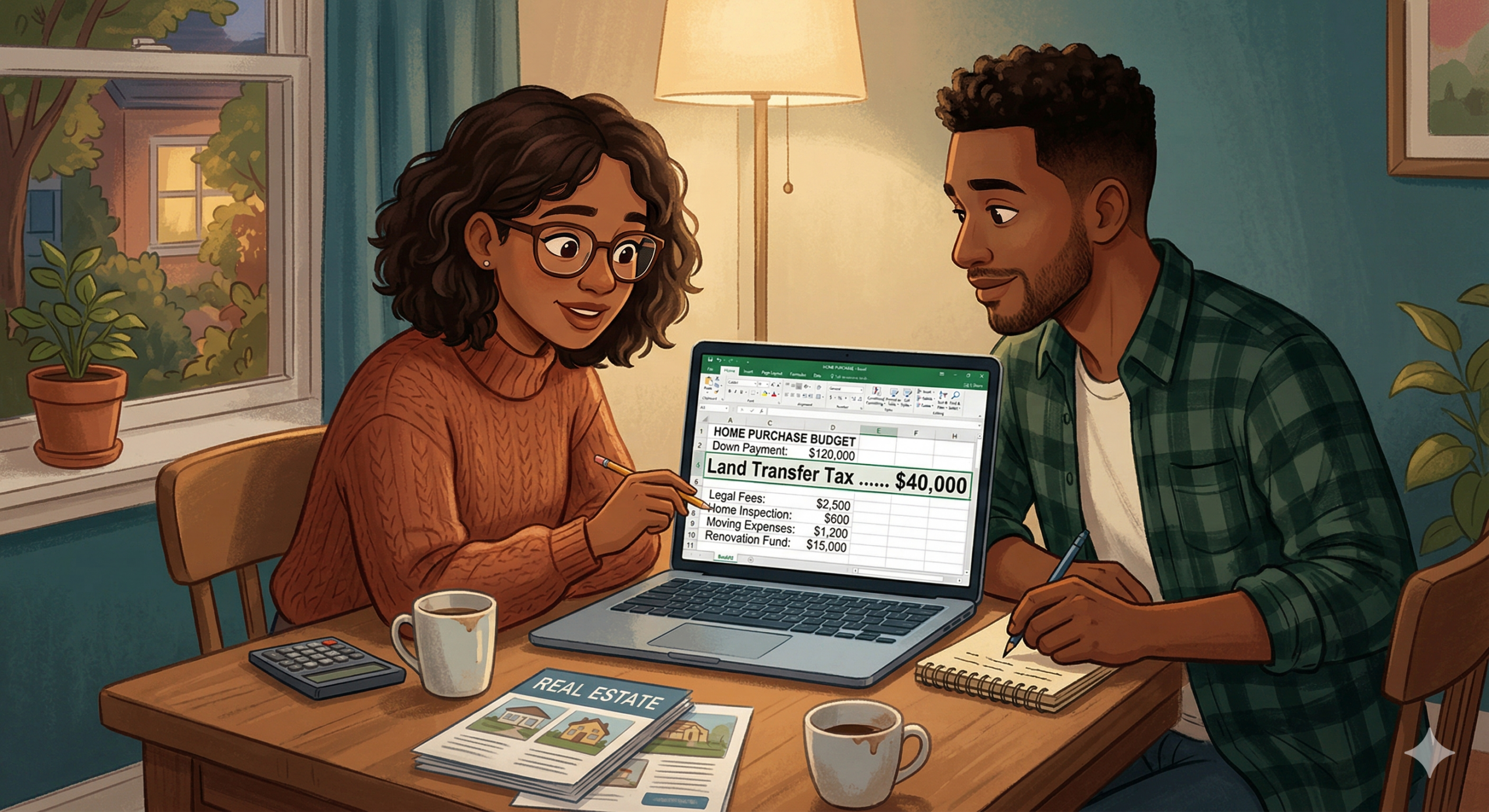
The most common mistake families make is treating land transfer tax in Toronto as a line item to worry about closer to closing. By that point, budget flexibility is limited and the discovery of a $40,000 to $65,000 additional cost can be disorienting.
The better approach is to build the land transfer tax estimate into your budget from the beginning of your search, before you have set a firm ceiling on what you are willing to spend. That means choosing a target purchase price, calculating the approximate combined tax at that price point, and ensuring your liquid funds at closing account for it alongside legal fees and any bridge financing requirements.
Families who are also selling a current property should factor in whether proceeds from their sale will be available at the time of closing, or whether there is a timing gap that requires additional planning. Our knowledgeable realtors work specifically with upsizing families and can help you think through the full financial picture of a move, not just the purchase price.
Location Choices Within Toronto Can Affect More Than Just Price
Since the municipal land transfer tax applies only within Toronto’s official city boundaries, some families near the edges of the city have the option of purchasing in adjacent municipalities where only the provincial tax applies. This is not a consideration that suits every family, and proximity to schools, community ties, and commute routes often matter far more than the tax differential.
For families who are open to exploring a wider geography, it is worth understanding how the tax structure differs across the region. Exploring Toronto neighbourhoods alongside adjacent communities can help clarify where the value equation makes the most sense for your family’s priorities.
For families whose search is firmly within the city, areas like Davisville Village and Birch Cliff continue to attract upsizing buyers who prioritize established community character alongside the school and transit access that Toronto neighbourhoods offer.
Work With Someone Who Understands the Full Cost of Upsizing
Land transfer tax in Toronto is one of the most significant costs in an upsizing transaction, and it is one that every family in this stage should understand clearly before finalizing a budget.
The broader picture of upsizing costs, including what your current home may be worth and how that equity positions your next purchase, is worth reviewing early. If you are beginning to think seriously about the move, understanding what the upsizing process looks like from a financial planning standpoint can help you enter the market with confidence rather than uncertainty.