For most Toronto families, the search for a larger home eventually leads to a familiar tension. The neighbourhoods with the most space tend to be the ones where a car is not optional. The neighbourhoods where you can walk to school, the farmer’s market, and the library without a second thought tend to have smaller lots and higher price points per square foot.
That tension is not absolute. There are walkable Toronto neighbourhoods where families can find both the square footage they need and the kind of daily walkability that changes how a community feels to live in. The key is knowing where those neighbourhoods are, what makes them genuinely walkable rather than just well-located, and how the trade-offs compare when you are buying with a ten-to-fifteen year horizon in mind.
Below is a look at some of the walkable Toronto neighbourhoods that consistently attract upsizing families, and what each one actually delivers for day-to-day life.
Why Walkability Matters More as Families Grow
Walkability is easy to undervalue when you are evaluating a home on paper. You are thinking about bedroom count, basement potential, backyard size, and commute distance to the office. Walkability feels like a nice-to-have rather than a need.
Over time, that calculus tends to shift. Families with children in school routines often find that a walkable neighbourhood changes the texture of daily life in ways that are hard to quantify but easy to feel. Children who can walk to school develop independence earlier. Parents who can run errands on foot reclaim time that would otherwise go to parking and transit logistics. Weekends feel different when coffee, groceries, and a park are all within ten minutes on foot.
Research on neighbourhood walkability consistently links pedestrian-friendly environments to higher levels of physical activity, stronger community connections, and long-term resident satisfaction. For families thinking about where they want to spend the next decade, walkability is increasingly treated as a quality-of-life variable, not just a commuting consideration.
Walkable Toronto neighbourhoods also tend to hold value well over time. Proximity to amenities, transit, and services supports sustained buyer demand, which matters when you are eventually thinking about resale.
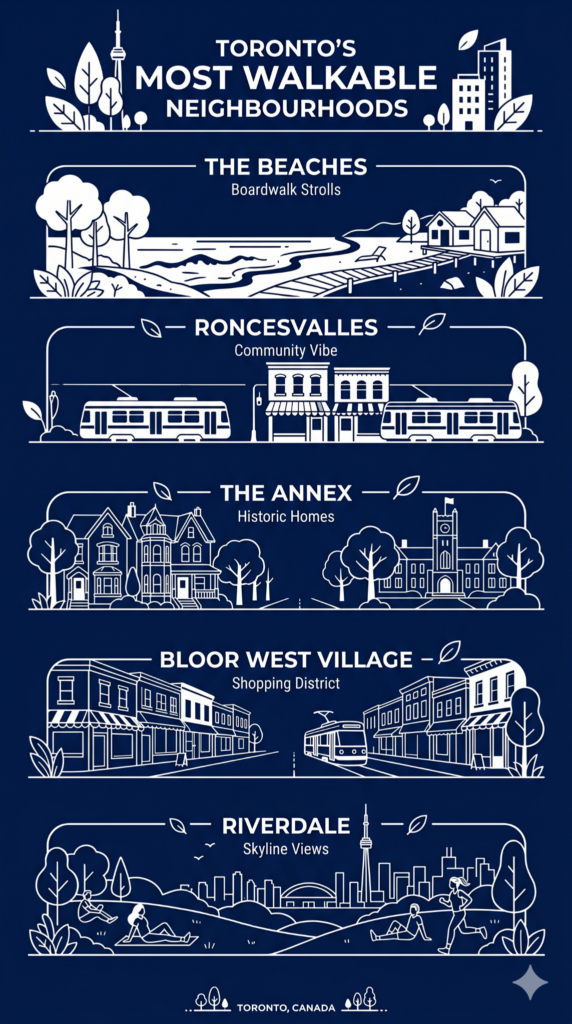
The Beaches: Lakefront Living With a Village Feel
Few walkable Toronto neighbourhoods deliver the combination of natural setting and daily convenience that The Beaches does. Stretching along the eastern waterfront, the neighbourhood centres on Queen Street East, where families have access to independent grocers, cafes, bookshops, and restaurants within a short walk of most residential streets.
The boardwalk and Kew Gardens park system give The Beaches a quality of outdoor life that families with children return to year-round. Proximity to the lake means summer weekends rarely require leaving the neighbourhood entirely.
The housing stock in The Beaches skews toward semi-detached and detached homes, many of them on quiet side streets running perpendicular to Queen. For families upsizing from a condo or townhouse, the neighbourhood offers meaningful space gains alongside one of Toronto’s most walkable main streets.
Roncesvalles: A Tight-Knit Community With Strong Pedestrian Infrastructure
Roncesvalles has built a reputation as one of the walkable Toronto neighbourhoods that genuinely earns the label. The main street runs through the heart of the community and supports a range of daily needs within walking distance, from specialty food shops and bakeries to the local library branch and several schools.
The neighbourhood is compact enough that most residential streets are a short walk from Roncesvalles Avenue itself, making the pedestrian infrastructure feel integrated rather than aspirational. Families with younger children appreciate that school routes are manageable on foot, and that the streetcar connection into downtown does not require a car.
Housing in Roncesvalles includes a mix of semi-detached homes and detached properties, often with the character and architectural detail of a neighbourhood built for long-term living. Lot sizes vary, but families looking for functional space in a genuinely walkable setting will find the neighbourhood worth exploring carefully.
Bloor West Village: Family Infrastructure Meets Daily Walkability
Bloor West Village ranks consistently among the walkable Toronto neighbourhoods that families return to as a top contender. The Bloor Street corridor supports a dense concentration of independent shops, grocery options, restaurants, and services, all within easy reach of the residential streets that run north and south.
What makes Bloor West Village particularly well-suited to families is the depth of its infrastructure. Strong school options, proximity to High Park, and a subway connection to the rest of the city mean that most daily needs and weekend activities can be addressed without leaving the immediate area.
The housing stock leans toward larger semi-detached and detached homes on tree-lined streets, giving families the combination of space and accessibility that defines the best walkable Toronto neighbourhoods. For move-up buyers considering the west end, Bloor West Village is worth including in any serious shortlist.
Riverdale: Space, Schools, and a Walkable Village Core
Riverdale draws families for several overlapping reasons, but its walkability is central to the neighbourhood’s sustained appeal. Danforth Avenue forms the commercial spine of the area, and the density of shops, cafes, and family-oriented businesses along that stretch supports daily errands on foot for most households.
The neighbourhood also benefits from Withrow Park, a large green space that functions as a community anchor across seasons. Skating in winter, weekend markets in summer, and open space for children throughout the year make the park an extension of the neighbourhood’s livability.
Families considering Riverdale will find housing stock that ranges from semi-detached homes to substantial detached properties. The east end pricing dynamic has historically made this one of the walkable Toronto neighbourhoods where families can access meaningful square footage at a relatively competitive price point compared to equivalent western neighbourhoods.
The Annex: Proximity to Everything, With Residential Depth
The Annex occupies a specific position among walkable Toronto neighbourhoods in that it borders the University of Toronto campus and sits steps from Bloor Street’s concentration of transit, shops, and cultural venues. For families where one or both partners work in the downtown core or at the university, the neighbourhood offers a rare combination of short commute and genuine walkability.
The residential streets that run north from Bloor into The Annex are notably quieter than the main arterial, and the housing stock includes some of the city’s most architecturally significant homes, many of them large Victorian and Edwardian detached properties. For families upsizing in this range, the neighbourhood rewards patient searching.
The Annex’s walkability extends into the evening and weekend in a way that many residential Toronto neighbourhoods do not. Access to independent cinemas, restaurants, cafes, and the Spadina subway line means the neighbourhood functions as a full-service community for families who want to reduce car dependency without sacrificing access to city life.

What to Look For When Evaluating Walkability Neighbourhood by Neighbourhood
Not all walkability is equal, and the label can be applied loosely. When evaluating walkable Toronto neighbourhoods for a family move, a few factors help distinguish genuine pedestrian-friendly communities from ones that simply have a transit stop nearby.
School proximity matters in a specific way. Walkability to school is different from a neighbourhood having a school within a kilometre. A genuinely walkable route for a child means safe crossings, sidewalks in good condition, and a path that does not require navigating a major arterial road alone.
Grocery access is another useful test. Families who can complete a weekly shop or daily top-up on foot have fundamentally different daily rhythms than those who schedule grocery runs around the car. Walkable Toronto neighbourhoods that support this pattern tend to have either a full-service grocery store within walking distance or a concentration of independent food shops that collectively meet household needs.
It is also worth thinking about how walkability intersects with the specific life stage your family is entering. Families with toddlers and young children experience walkability differently than families with teenagers. A neighbourhood that is ideal for parents pushing a stroller may become even more valuable as children gain independence and begin moving through the community on their own.
For a broader look at how different Toronto communities compare on these dimensions, exploring the full neighbourhood guide can help you develop a more complete picture of what each area offers across school, transit, parks, and housing mix.
Balancing Walkability With Space and Budget
The most walkable Toronto neighbourhoods are typically among the most in-demand, which creates a real tension for upsizing families whose primary motivation is gaining square footage. The question is often whether the walkability premium is worth it given your family’s actual priorities.
For some families, the answer is clearly yes. If school proximity, reduced car dependency, and a strong sense of community are high on the priority list, the cost of entry into a walkable neighbourhood may represent a value calculation that holds up well over a long ownership period.
For others, the better decision involves finding a neighbourhood that scores well on walkability without sitting at the very top of the market. Several walkable Toronto neighbourhoods in the east end and inner suburbs offer meaningful pedestrian infrastructure at price points that leave more room in the budget for the home itself, the renovation, and the flexibility that comes with financial margin.
Families navigating this balance often find it useful to think through the decision the way they would a long-term investment, considering how their current home fits into their financial strategy and what they are optimizing for in the next property.
Reviewing current listings across multiple walkable Toronto neighbourhoods simultaneously can help calibrate expectations, particularly when comparing what similar budgets deliver in different parts of the city.
The Neighbourhood Shapes More Than the Address
Choosing a home is choosing a daily environment. For families in Toronto, that environment is shaped as much by what surrounds the home as by the home itself. A walkable neighbourhood does not just reduce driving. It changes how children develop independence, how parents experience morning routines, and how deeply families become embedded in their community over time.
The walkable Toronto neighbourhoods profiled here each offer something distinct in terms of character, housing stock, price point, and proximity to different parts of the city. None of them is the obvious choice for every family, but each of them is worth understanding on its own terms before making a decision as significant as an upsizing move.
Every neighbourhood on this list has a different personality at street level, and the gap between what a neighbourhood looks like on paper and what it feels like to live in can be significant. Families who want to move beyond the data and understand how these communities actually function day to day can start that conversation.